
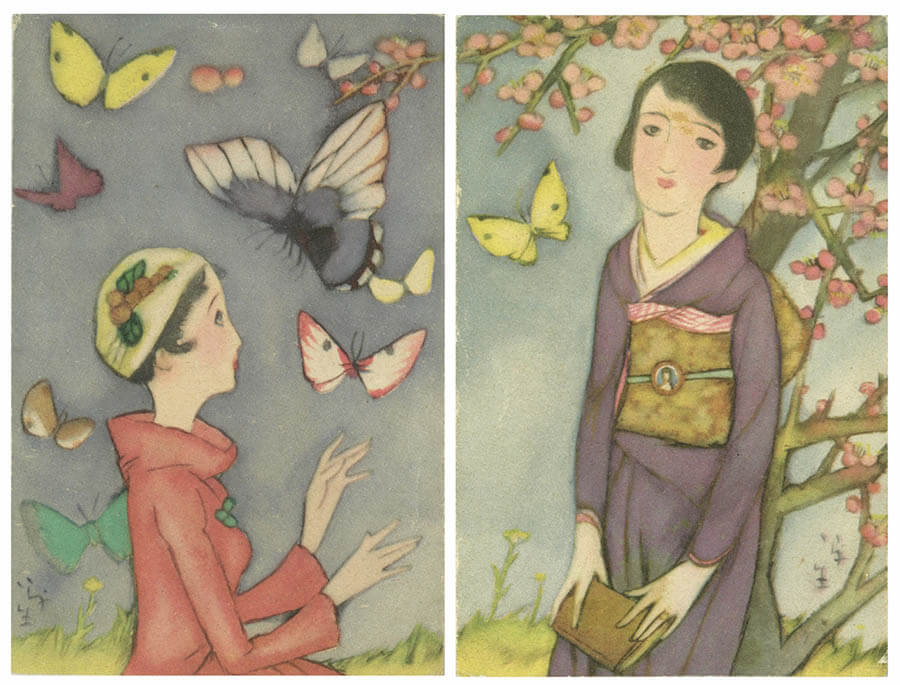
Yumeji Takehisa was born in Okayama in 1884. At 18, he moved to Tokyo and began drawing small illustrations for magazines and newspapers. After that, he opened the Minatoya Picture Book Shop in Nihonbashi with Tamaki Kishi, the only woman he ever formally married. There, he sold items featuring his own designs, such as chiyogami (decorative paper), letter paper, and envelopes. The shop also functioned as a gallery, where young artists to exhibit and present their works.
Yumeji and the Allure of Taishō Romance
The women depicted in Yumeji’s art came to symbolize the “Taishō Romance” era. His graceful, slender figures with melancholic expressions and a touch of decadent charm captured the hearts of young men and women alike, becoming known as “Yumeji-style bijin-ga”—his signature portraits of beautiful women.
The Women Behind Yumeji’s Art

Yumeji spent his life searching for the image of his “eternal woman.” This search appeared not only in his art but also in his personal life. His love life was full of ups and downs, centered on three women who inspired his work:
- Tamaki Kishi – the only woman he officially married (left)
- Hikono Kasai – his beloved partner (middle)
- Oyo (Kayo Sasaki) – another important source of inspiration (right)
Love, Loss, and Yumeji’s Greatest Work
Among the three women, Hikono left the deepest mark on Yumeji’s heart. At the time, Yumeji was married to Tamaki, who was two years older, but their marriage ended in only about two years. Even after the divorce, they continued an unusual life together—sometimes living apart, sometimes together—and had three sons.
While still bound to Tamaki, Yumeji met Hikono, who was twelve years younger and about to transfer to the Women’s Art School. Drawn together by both love and art, the two began living in Kyoto, almost like an elopement. But their happiness was short‑lived: in 1918, Hikono contracted tuberculosis and died at the young age of twenty‑three.
Heartbroken by the loss of his dearest love, Yumeji poured his grief into his art, creating what is considered his masterpiece, The Black Ship (Kurofune).

Painting Feelings
Yumeji is best known for his portraits of women. Unlike the perfect, idealized beauties of traditional Japanese art, his women look soft and emotional, often with a hint of sadness in their eyes. Their poses and expressions reflect feelings like love, nostalgia, and quiet loneliness.
Yumeji’s Travels and His Final Days
In the 1920s, Yumeji traveled to Europe and the United States, hoping to expand his horizons and learn from modern Western art movements. He observed new trends, visited museums, and absorbed the artistic atmosphere of the time. However, his work—deeply rooted in Japanese sensibility and the sentimental beauty of the Taishō era—did not gain the recognition he had hoped for abroad, particularly in the United States.
After returning to Japan, his health steadily declined, yet he continued to paint and create until the very end. In 1934, at the age of just forty‑nine, Yumeji passed away, leaving behind a legacy of art that continues to captivate viewers with its unique blend of romanticism and melancholy.
Yumeji’s Legacy Today
Yumeji’s world of soft, lyrical beauty is still celebrated today. His works are preserved in the Yumeji Art Museum in Okayama and the Yumeji Kamakura Museum, where visitors can step into his poetic vision of the Taishō era. His style continues to inspire artists, designers, and fans of Japanese art.
