
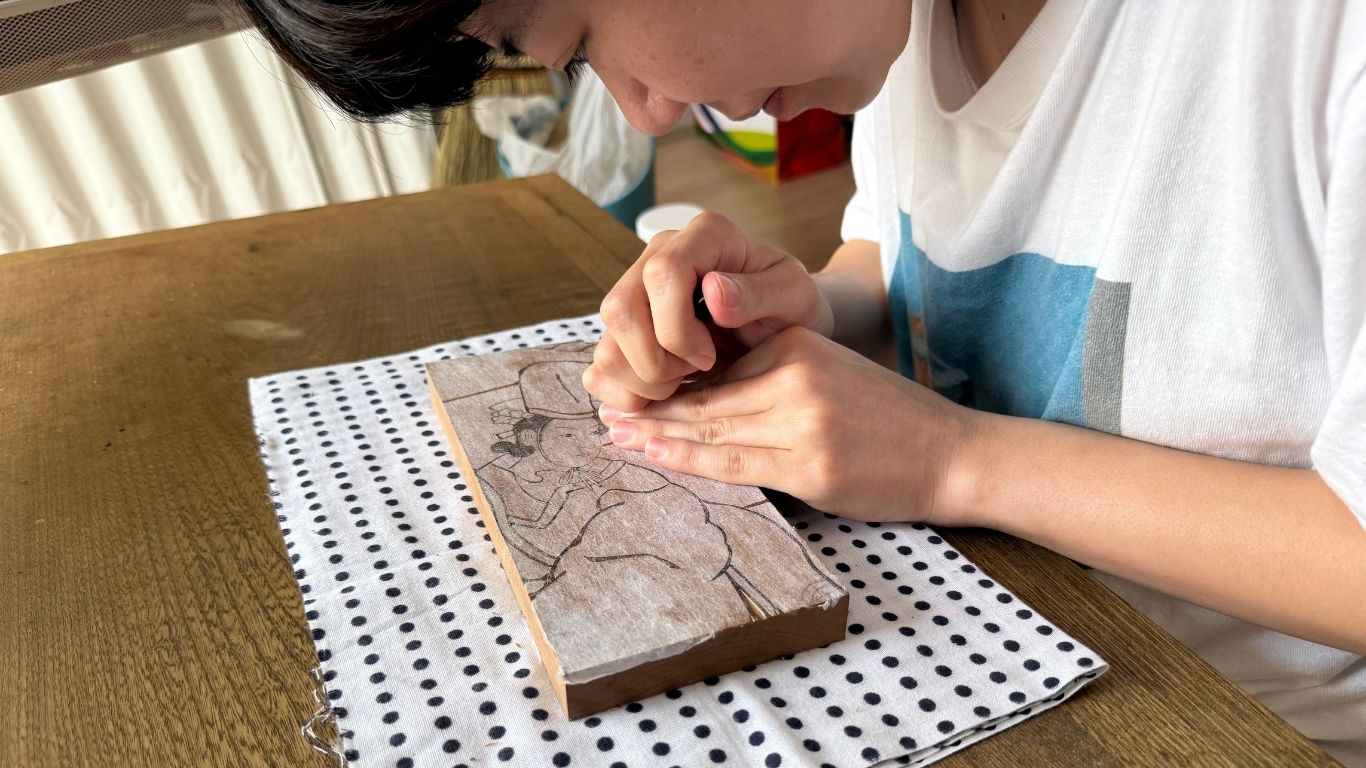
The story of shokunin Sayumi, a young female artisan keeping the art of Ukiyo-e alive through her hands.
In a quiet workshop in Tokyo’s Arakawa Ward, the scent of freshly carved wood fills the air. Sayumi, one of the few women in the world of ukiyo-e woodblock print carving, patiently continues her work with her tools in hand. Her hands bridge the gap between past and present, blending precision with emotion to carry Japan’s tradition forward into modern life.
The Path of a Female Ukiyo-e Artisan in Japan

On her worktable lies a neat row of carving knives, each one shaped by years of use. When Sayumi picks one up, she sees not just the work ahead but the warmth of the hands that will one day hold her finished print.
Her journey began while studying craft design at the Japan Design College in Tokyo. Among all materials such as clay, metal, and glass. It was wood that resonated her most deeply. “Wood is a living material,” she recalls. “The more you touch it, the more it responds to your emotions.”
After graduation, she decided not to apply to Tokyo University of the Arts. “I wanted to make something with my hands, not just design on paper.” Soon after, she found a traditional apprenticeship program in Arakawa Ward and met the master who would shape her career.
During her apprenticeship interview, he asked,
“This tradition may disappear one day. Are you still willing to do it?”
Her answer was clear,
“Because it might disappear — I want to do it.”
From that moment, she began carving not only wood, but her own path as a Ukiyo-e carver.
Apprenticeship of a Young Female Ukiyo-e Woodblock Carver

Before dawn each day, the quiet workshop echoed with the rhythmi curving of wood. “Training wasn’t about learning techniques,” she says. “It was about learning the atmosphere — the air of the workshop.”
Every gesture mattered, how to hold the knife, how to breathe, when to pause. Nothing was taught directly. It had to be absorbed through patience and observation. As she recalls, “We learned by watching, stealing, and remembering.”
At first, her days of apprenticeship were filled with mistakes. A slight tilt of the blade could ruin a line when curving a wood. Even after many attempts, her master’s approving never came but she never stopped working hard.
“I chose this path. What was being tested wasn’t my skill — it was my heart.”
After 7 years of practice, she finally earned her independence from her master. He told her,
“Your technique isn’t complete yet. But your hands no longer lie.”
Those words, she says, still echo through every carving she does.
The Art of Ukiyo-e Carving — A World Born from Her Hands

Sunlight shines on the workbench as her knife glides across the wood’s surface. A single line, barely a few millimeters wide, seems to awaken the spirit hidden within the block. Sayumi’s work is known for its delicacy, as if images sleeping within the wood had been waiting for her to release them.
“Carving is like having a conversation with the wood,” she says. Each block behaves differently, grain patterns, humidity, and even the warmth of her hands influence the sensation of carving. Every piece has its own rhythm, and she adjusts her movements to follow the flow of the grain. “If I try to control it too much, the wood resists,” she explains. “When I listen carefully, it tells me where to go.”
She specializes in fine linework and the expression of light. When recreating classic Ukiyo-e prints, she adjusts the carving depth by tenths of a millimeter to capture the subtle air of the original. “I’m always trying to carve the light hidden inside the wood.”
Through collaboration with contemporary frame makers, her work blends the softness of tradition with the strength of modern design. A dialogue where past and present intersect resides within her hands.
“Once a piece leaves my hands, it grows inside someone else’s life.”
Female Ukiyo-e Carver’s Pride — Balancing Gentleness and Strength

For generations, the world of Ukiyo-e carving belonged almost entirely to men. Sayumi, however, believes that her perspective as a woman offers a different kind of strength.
“When I carve, I don’t push — I listen,” she says. Softness, to her, isn’t weakness. It’s sensitivity which reads the wood’s subtle energy and responding with care.
Sometimes people express surprise like “I didn’t know women could do this.” She smiles and replies,
“I think I can do it because I’m a woman.”
Her words hold both gentleness and defiance. It is a quiet strength that redefines the role of traditional artisans in modern Japan. “For me, carving is not about power, but about connection,” she says. It is precisely this refined technique that makes her art unmistakably her own. Elegant, patient, and vibrant.
Daily Life of a Young Female Ukiyo-e Woodblock Carver in Tokyo

Every morning, she turns on the radio, lets her steady hands work to the flow of soft music and conversation. Around noon, she exchanges techniques with local artisans, seeks advice, and sometimes shares lunch and conversation.
In Arakawa, there exists a community of artisans who continue to practice Japanese traditional crafts within their daily lives. At dusk, Sayumi stops her carving and prepares dinner. “Even when I’m not working in the evening, I find myself thinking about my work,” she says with a laugh. “But that’s just part of who I am.”
Her daily life may seem ordinary. Yet within its steady rhythm lies the very essence of craftsmanship itself: humble, human, and unchanging. The hands that uphold tradition move gently and faithfully, day after day.
