
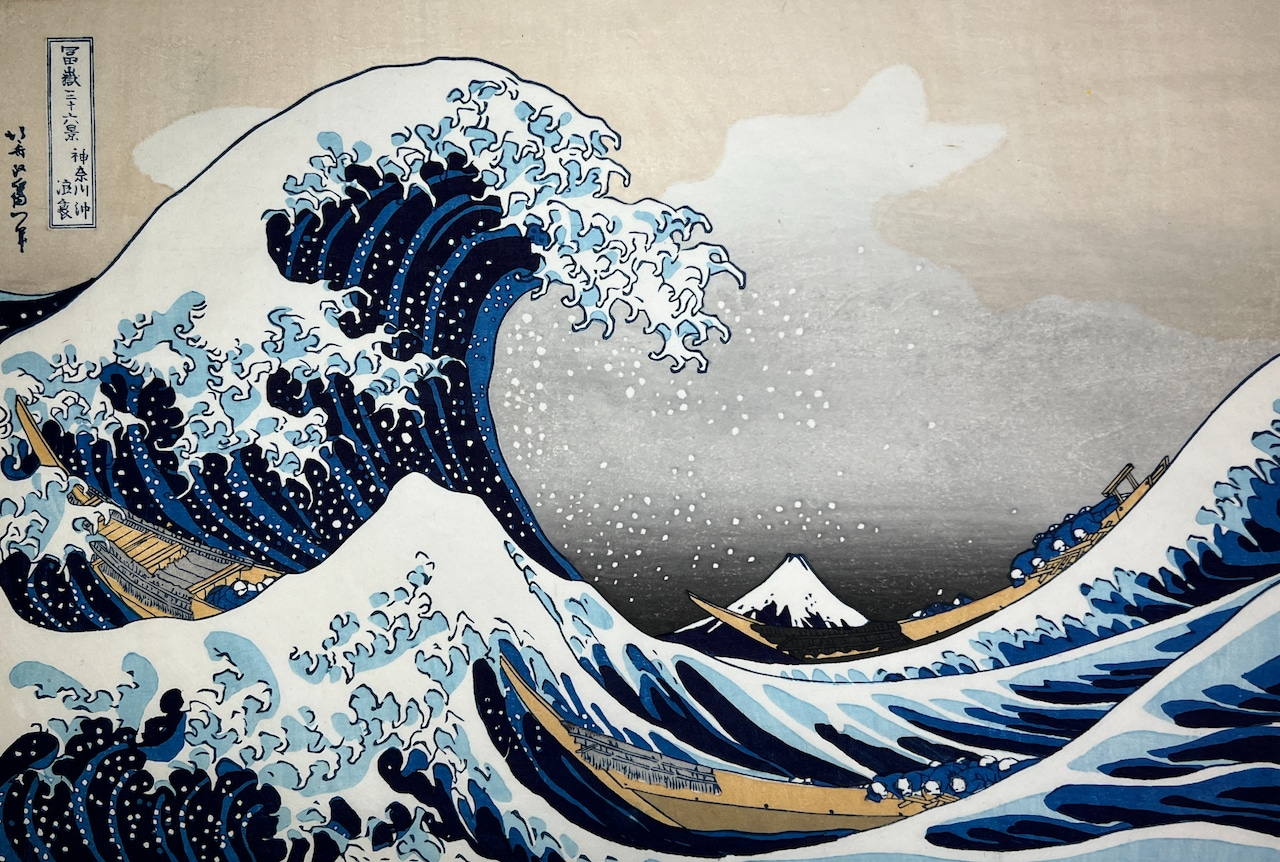
A giant wave rises, curling like a claw, ready to crash down on three tiny boats. Far in the distance, Mount Fuji sits quietly, watching it all.
This is The Great Wave off Kanagawa—a single moment frozen in time that has traveled nearly 200 years across oceans and cultures to become Japan’s most famous artwork.
Born in Edo, Loved Worldwide

In 1831, during the peaceful Edo period, artist Katsushika Hokusai carved this scene into a wooden block. It was part of his Thirty-Six Views of Mount Fuji, a series that captured the sacred mountain from every angle—near, far, gentle, and dramatic.
Among all these works, this wave—known in Japanese as 神奈川沖浪裏 (Kanagawa-oki Nami Ura)—quickly became the star.
The Seascape That Inspired the Great Wave

According to Hokusai’s careful sketching and historical records, the scene is believed to have been observed from a vantage point off the coast of Kanagawa, looking toward the Honmoku area. In today’s geography, this spot would roughly align with the waters stretching from Yokohama Bay Bridge to Daikoku Pier, where the shallow offshore currents and open horizon create the perfect stage for a towering wave to rise against the distant silhouette of Mount Fuji.
A Secret Fuji in the Wave

If you look closely at Hokusai’s Great Wave and you might notice a secret: there is another Mount Fuji hidden within the wave itself.
Just to the left of the distant, tiny Mount Fuji, a curling wave rises in the shape of a perfect triangle, mirroring the mountain’s iconic silhouette.
This clever use of triangular composition gives the artwork a sense of stability and balance—its base wide, its peak narrowing gracefully.
A Moment of Power and Calm
What makes this wave unforgettable isn’t just its shape or color, but the feeling it leaves behind.
- The wave looks alive, curling like it might swallow the boats in a heartbeat.
- Yet Mount Fuji stays still and calm, reminding us that nature is both fierce and eternal.
Hokusai even used Prussian blue, a new imported pigment at the time, to make the sea deep and striking. This bold color helped the wave leap off the page, catching the eye of anyone who saw it.
The Wave’s Journey Across the Seas

After Japan opened to the world in the 19th century, The Great Wave sailed into Europe, where artists like Van Gogh and Monet fell in love with its bold style.
It inspired paintings, music, and design far beyond Japan. Today, you can find it everywhere—in museums, on posters, and now, even on Japan’s new 1,000-yen note.
Bring this iconic masterpiece into your home — shop The Great Wave off Kanagawa (Kanagawa-oki Nami Ura) by Hokusai here to experience traditional Japanese craftsmanship. Each piece is created by skilled master artisans (shokunin) using the same methods from the Edo period.
