
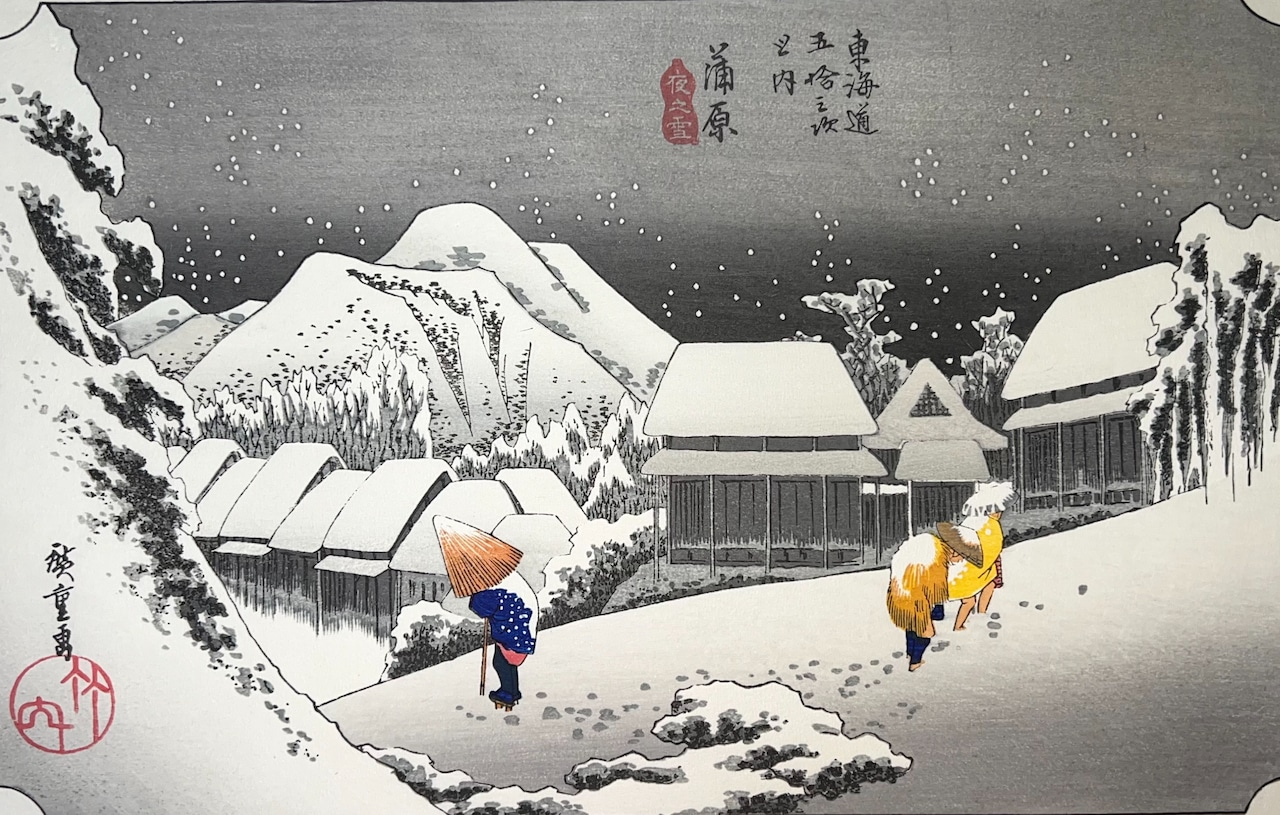
Ukiyo-e (浮世絵), meaning “pictures of the floating world,” is one of Japan’s most iconic art forms. Behind each mesmerizing print lies the collaboration of several skilled artisans known as shokunin (職人), each mastering a specific stage of the woodblock printing process. From the initial design to the final print, ukiyo-e is the result of a highly orchestrated tradition refined over centuries. In this article, we delve into the fascinating roles of the shokunin and their intricate techniques in creating ukiyo-e.
1. The Designer (Eshi / 絵師)
The creation of every ukiyo-e print begins with the eshi (絵師), the master designer who imagines and composes the image. More than a draftsman, the eshi is a visual storyteller — an artist who fuses cultural knowledge, artistic innovation, and technical skill to craft scenes that reflect the spirit of the time. In the collaborative tradition of ukiyo-e, the eshi is the originator, the visionary who sets the creative process in motion.
From Imagination to Ink
The eshi begins by drafting the shita-e (下絵), or “under-drawing” — a detailed composition that serves as the blueprint for the entire print. Drawn with fine brushes and sumi ink (black ink made from soot and natural glue) on thin washi paper, the shita-e captures the full emotional and structural intent of the final image. Every line must be confident, expressive, and perfectly placed, as it will be transferred directly to the woodblock and destroyed during the carving process.
Despite being a preparatory step, the shita-e is a fully realized work of art, reflecting the eshi’s careful attention to gesture, rhythm, and visual flow.
Subject and Style: The World of the Floating World
Ukiyo-e means “pictures of the floating world,” and the eshi’s role is to distill that world onto paper — to capture theater actors, courtesans, landscapes, folk tales, and moments of everyday life with beauty and immediacy.
Common themes include:
- Bijin-ga (美人画): Portraits of elegant women, often with refined poses and elaborate hairstyles.
- Yakusha-e (役者絵): Dynamic depictions of kabuki actors in mid-performance.
- Meisho-e (名所絵): Scenic views of famous places across Japan.
- Musha-e (武者絵): Heroic warrior prints drawn from legend and history.
- Yōkai and kaidan: Ghosts, spirits, and supernatural beings from folklore.
The eshi’s style varies by subject: soft and sensual for bijin-ga, bold and theatrical for yakusha-e, atmospheric and poetic for landscapes. A master eshi understands how to tailor linework, posture, and expression to evoke the right mood and draw the viewer into the scene.
Linework as Language
The hallmark of a skilled eshi lies in their command of the brush. With limited use of shading or color, the eshi must convey emotion, motion, and meaning through the purity of line. Facial expressions are stylized yet nuanced, hands are elegantly posed, and garments ripple with movement. What may appear simple is the result of practiced economy and deep visual sensitivity.
Because the shita-e is carved away during block preparation, the eshi has one chance to get it right. There are no erasers — only confidence and control.
Masters of the Craft
Throughout ukiyo-e history, certain eshi have come to define the art form:
- Katsushika Hokusai, whose iconic Great Wave and Thirty-Six Views of Mount Fuji revolutionized composition.
- Utagawa Hiroshige, known for lyrical landscapes that capture seasonal beauty and travel.
- Kitagawa Utamaro, master of portraying feminine grace and the quiet intimacy of daily life.
- Toshusai Sharaku, who explored the dramatic psychology of kabuki actors in his intense portraits.
Each of these artists brought a unique voice to the ukiyo-e tradition, shaping the visual culture of their time and influencing generations to come.
The Eshi’s Legacy
Though only the printed version of their art survives, the invisible hand of the eshi is felt in every curve and contour of the final image. Their drawing is the seed from which the entire collaboration grows — the moment when imagination first takes shape.
2. The Carver (Horishi / 彫師)

If the eshi is the soul of the print, the horishi (彫師) is its sculptor — the artisan who gives physical depth and form to the drawn image. The horishi translates the delicate brushwork of the shita-e into intricate wood carvings, using their hands to preserve and faithfully reproduce the artist’s vision. It is a task that requires not only technical mastery but also immense sensitivity to the nuance of line and expression.
Once the eshi’s design is complete, it is pasted face-down onto a block of cherry wood — prized for its density and fine grain — and becomes a sacrificial guide. As the horishi carves, the original drawing is gradually sliced away, each line transformed into relief. This is a moment of profound precision: with every cut, the horishi must capture the essence of the brushstroke, mimicking the flow and rhythm of ink with tools made of steel and bamboo.
A Symphony of Tools and Hands
The horishi employs a variety of specialized blades:
- Hangi-to for outlining,
- Koma-nomi and aisuki for clearing larger spaces,
- and ultra-fine chisels for details such as hairlines or text.
The tools must be razor-sharp — and so must the mind of the horishi. A single hesitation, a slip in pressure or angle, and the line may be lost forever. There is no undo in wood.
Carving in Layers: The Dance of Color Blocks
For a full-color ukiyo-e print, the horishi doesn’t carve just one block, but a set of them:
- The keyblock (omohan), carved first, contains the black linework.
- Subsequent color blocks (irohan) are carved for each pigment area — sometimes five, ten, or more — all perfectly aligned.
To achieve this, the horishi works closely with the eshi’s design to identify areas of color and ensures that the blocks will register (align) flawlessly during printing. Kento marks — carved notches in the corner and side of each block — serve as precise guides during the printing process.
The Invisible Art of Preservation
Although the horishi’s hand is vital, their work is often invisible in the finished print. The ideal horishi does not interpret, but honors the eshi’s intent, recreating the original linework with almost spiritual devotion. In many cases, viewers are unaware that the entire artwork has been sculpted by hand.
Yet it is this very humility and discipline that defines the horishi. Their reward lies in the moment the first proof print reveals that the carved lines have not merely survived the transition to wood — but have taken on new life.
In traditional studios, horishi were held in high regard and often specialized in a particular artist’s style. Today, their knowledge is passed down through intensive apprenticeship, preserving techniques that have remained virtually unchanged for centuries.
3. The Printer (Surishi / 摺師)

If the eshi envisions and the horishi prepares, it is the surishi (摺師), the printer, who breathes life into the work — transforming carved wood and black lines into vivid color and texture. Working with ink, paper, and pressure, the surishi completes the final and most visible step of the ukiyo-e process, where all the efforts of the collaborative team come together on a single sheet of paper.
The Master of Ink and Paper
The surishi is a true craftsman of rhythm and repetition. Using the carved woodblocks, they print each sheet entirely by hand, applying ink with soft brushes and transferring the image onto washi (handmade Japanese paper) by rubbing with a tool called a baren — a flat, disc-like pad made of braided bamboo and paper.
Each color in the print is added in a separate pass using a different block. A single ukiyo-e print may require anywhere from 5 to 20 separate impressions, with each one demanding absolute precision in alignment. The surishi must ensure that every layer of color registers perfectly, using carved kento (registration marks) on the blocks to guide placement. Even the slightest shift can throw off the image.
The Sensory Art of Printing
Unlike machine printing, the surishi does not simply repeat a mechanical motion. Every print is hand-finished, requiring the artisan to adjust ink thickness, moisture, pressure, and brush technique for every single sheet. Changes in humidity, paper texture, or pigment behavior may demand immediate, intuitive corrections.
Among the surishi’s most subtle skills is the ability to create gradation effects, known as bokashi. This involves applying ink unevenly — fading it with a brush or gently wiping it away — to produce mists, sunsets, shadows, and other painterly transitions. Such effects require extraordinary finesse and are among the most admired techniques in ukiyo-e.
A Dialogue Between Color and Form
The surishi’s palette traditionally consisted of natural dyes and pigments — indigo, safflower red, turmeric yellow, and later Prussian blue — which were often mixed fresh each day. By carefully layering these colors, the surishi not only replicates the eshi’s vision but also interprets it, making subtle decisions about hue, texture, and saturation.
Thus, while their role is rooted in repetition and consistency, the best surishi bring a painter’s sensitivity to each impression. A master printer knows how to evoke softness in skin, depth in mountains, or shimmer in fabric — all through ink and pressure.
Collaboration and Mastery
Just like the eshi and horishi, the surishi undergoes years of apprenticeship, often training under a senior printer to understand the materials, timing, and flow of the craft. They also work closely with the hanmoto (publisher) and often coordinate testing stages called kyōgō-zuri — trial proofs used to finalize color decisions before a full run is printed.
The finished product — the ukiyo-e print that survives for centuries — is a silent testament to the surishi’s labor, judgment, and skill. Though their hand may not sign the work, every stroke of color bears their invisible signature.
4. Publisher (Hanmoto / 版元)
Behind every successful ukiyo-e print — behind the brush, the chisel, and the baren — stands the often-unseen figure of the hanmoto (版元), or publisher. While not a craftsman in the traditional sense, the hanmoto plays an indispensable role: they are the project’s producer, financier, editor, and distributor. Without their vision and backing, the collaborative process between the eshi, horishi, and surishi could never take shape.
The Orchestrator of Collaboration
The hanmoto begins by commissioning a project — selecting the subject, artist, and intended audience. They often pair popular eshi with proven carvers and printers, building a trusted team to execute the work. These publishers held deep knowledge of the market and knew how to anticipate and shape public demand.
The hanmoto’s role includes:
- Negotiating contracts and payments for each artisan.
- Approving designs, often giving feedback to align with audience interests.
- Overseeing proofing stages like the kyōgō-zuri (test prints) to fine-tune colors and composition.
- Funding materials — woodblocks, paper, and pigments — and managing printing runs, which could range from a few hundred to several thousand copies.
Though they did not hold the brush or the knife, the hanmoto’s decisions influenced every detail of production.
A Savvy Businessman and Cultural Curator
Operating during the Edo period’s tightly regulated publishing environment, hanmoto had to navigate strict censorship laws. They often included the names of their studios or seals on the final prints, assuming legal responsibility for content. This made them especially attuned to the political and social climate — careful not to provoke the authorities, yet eager to entice the public.
The hanmoto was also responsible for marketing and distribution. Prints were sold in shops, on the street, at festivals, and through booklets or picture albums. The hanmoto might produce entire series centered on a theme — such as the famous Thirty-six Views of Mount Fuji or Fifty-three Stations of the Tōkaidō — enticing collectors to buy each new release.
In many ways, hanmoto functioned like modern creative producers, combining art direction with business strategy to launch some of the most enduring works in Japanese visual culture.
Legacy of the Hanmoto
Some of the most respected publishers became cultural powerhouses in their own right. Names like Tsutaya Jūzaburō, Eijudō, and Nishimuraya Yohachi are still recognized for their refined taste and entrepreneurial flair. They elevated ukiyo-e from street art to collectible masterpieces, shaping its trajectory for centuries.
The hanmoto’s studio was often the heart of the ukiyo-e world — where ideas were born, projects assembled, and artworks delivered into the hands of a fascinated public. Their role, though sometimes overshadowed by the artists, was crucial in sustaining the golden age of Japanese woodblock printing.
The Harmony of Four Hands
The creation of ukiyo-e was not the work of a lone genius, but of four interdependent masters — the designer, the carver, the printer, and the publisher — each contributing their unique craft to a unified vision. Their collaboration exemplifies the essence of shokunin spirit: humility, excellence, and devotion to one’s craft.
Together, they transformed ink and paper into worlds of elegance, drama, and fleeting beauty — inviting viewers, then as now, to pause and marvel at the art of the floating world.
